

Century Connect is an API-first digital business platform designed to support complex telecommunications merger and acquisition activities through out-of-the-box, configurable application components.
It enables telecom operators and private equity sponsors to monetize acquired assets from Day 1, without system migration or service disruption.
Shaped by Excelacom’s telecom expertise and experience supporting Tier 1 M&A transactions, Century Connect delivers a structured, phased execution model built around immediate commercial enablement and long-term portfolio scalability.

New acquisitions onboarded and monetized, no migration required
Speed to Market

Unified catalog and ordering environment active from the moment the deal closes
Immediate Revenue

Zero system migrations needed to start selling; legacy systems stay in place
Zero Disruption
“Century Connect enabled our fiber infrastructure to plug directly into our partner’s ecosystem, allowing our partner to manage customer relationships while Metronet focuses on building and operating the network.”
- Craig Cowden, Chief Technology Officer at Metronet
Powered by intelligent agents and AI-driven automation, Century Connect reduces M&A integration timelines from years to months. Our AI agents operate across legacy and modern environments, enabling rapid integration of both TM Forum API compliant systems and legacy systems, without native API support.
Analyzes legacy OSS platforms without documentation or source code. Identifies data patterns, infers relationships, and generates complete data models.
What previously took months of reverse engineering is completed in days rather than months.
Translates inferred legacy data models into TMF SID-aligned interfaces automatically, connecting legacy data structures to modern standards in days rather than months.
Applies intelligent data transformations, manages reference data, and ensures bidirectional consistency between systems.
Selects the optimal integration path per transaction based on what each legacy system can support.
Whether API, direct database access, SOAP, file exchange, or RPA, the platform manages these tools per transaction, selecting the optimal method, without modifying the underlying system.
Supports a federated service catalog and inventory spanning BSS, OSS, and network domains across all technologies.
Service topology and TMF SID-aligned models capture dependencies and relationships, enabling consistent service delivery across heterogeneous environments while preserving the integrity of existing systems.
Mergers and acquisitions remain a key growth strategy for telecom operators, enabling rapid market expansion, spectrum acquisition, and access to new customer segments. However, while deal execution has become increasingly sophisticated, post-merger integration remains the dominant source of risk, cost, and delayed value realization. The challenges operators face are not isolated technical issues, but systemic constraints rooted in organizational fragmentation, system heterogeneity, and decades of network evolution.

Customers remain tied to legacy brands, systems, and processes, preventing a unified experience.

OSS and BSS platforms cannot interoperate natively, forcing costly and risky migration projects.

Launching unified products across acquired networks takes too long and often delivers inconsistent results.

Commercial, IT, and operations teams continue to work in silos, slowing decisions and execution.
Given the structural challenges of telecom mergers and acquisitions, successful integration cannot be achieved through a single, monolithic program. Operators must address two competing realities: the need for immediate operational continuity and the necessity of long-term optimization and simplification. Attempting to solve both simultaneously often leads to extended timelines, elevated risk, and delayed value realization.
Excelacom’s phased approach to M&A integration separates these objectives, allowing organizations to move quickly where speed matters most, while preserving the flexibility required for deliberate transformation.

The first phase focuses on ensuring that the combined organization can operate as a single business from Day 1. The objective is not structural consolidation, but functional continuity. Products must be sellable, orders must flow across networks, and customers must experience uninterrupted service, regardless of how many underlying systems are involved.
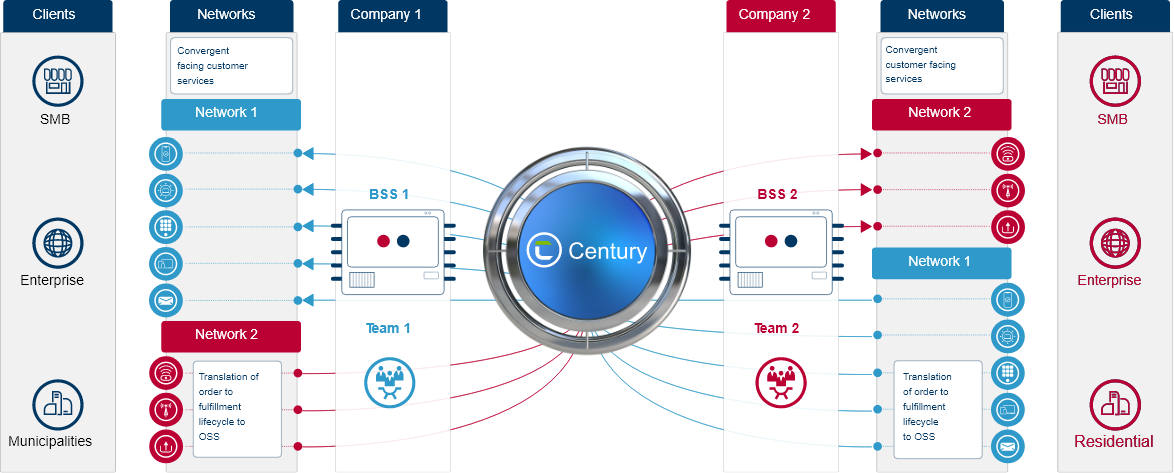
Phase 1
Enable immediate monetization while minimizing disruption
AI-assisted product mapping and templates for fast onboarding of acquired offerings.
API adapters or lightweight connectors expose inventory, provisioning, work orders and field service functions. Eveny buses ensure synchronization across systems.
Acquired customers and assets are visible via quick-win dashboards for sales and support.
Offers are made available in CPQ, eCommerce, agent portals and cross-sell/bundled with existing products.
A single, unified product and ordering layer operates across both organizations without disruptive system migrations, enabling rapid monetization and immediate cross-sell opportunities. By avoiding early migrations, operators reduce operational risk, protect revenue streams and establish stability across the newly combined environment.
Once operational stability is achieved, integration can shift toward long-term value creation. The second phase focuses on reducing complexity, improving efficiency and building a scalable foundation for future growth.
This phase introduces gradual product harmonization, system consolidation and data unification. Redundant portfolios can be rationalized, duplicate platforms retired and customer and inventory data progressively aligned. Because these activities are decoupled from immediate business operations, they can be executed in a controlled manner, aligned with budget cycles, regulatory constraints and organizational readiness.
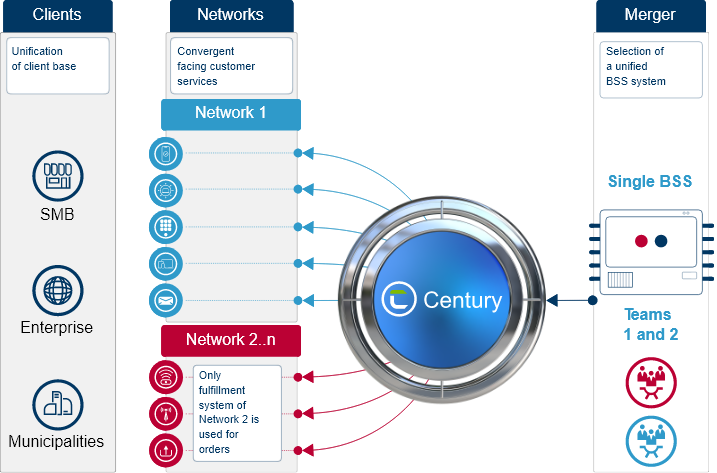
Phase 2
Capture long-term value by rationalizing, consolidating and unifying products, systems and data
Canonical, TMF-aligned product mapping and rationalization of overlapping SKUs.
Migration of billing, CRM, provisioning and retirement of duplicate platforms.
AI-assisted cleansing and deduplication, with full migration of customers, contracts and inventory.
Compliance checks, anomaly detection and unified KPIs and insights.
Products, systems and data are unified into a single operating framework, creating a streamlined and scalable environment for long-term growth.
If you’d like to explore Century Connect’s integration approach in more detail, our white paper takes a deeper look at the methodology behind it.
Century Connect delivers tangible benefits that accelerate M&A execution, while simplifying operations across both organizations. Its API-first architecture enables immediate selling of all products to create a unified catalog and order environment from Day 1. These capabilities translate into:

New acquisitions can be integrated into the framework in as little as 3-6 months, allowing rapid monetization of products and customers

By simplifying the BSS landscape, Century Connect enables higher productivity for sales teams and customer-facing agents

The platform reduces integration effort and total cost of ownership by rationalizing overlapping systems and streamlining workflows

A federated product catalog and centralized offer modeling support multiple catalogs and APIs, ensuring flexibility for future transactions
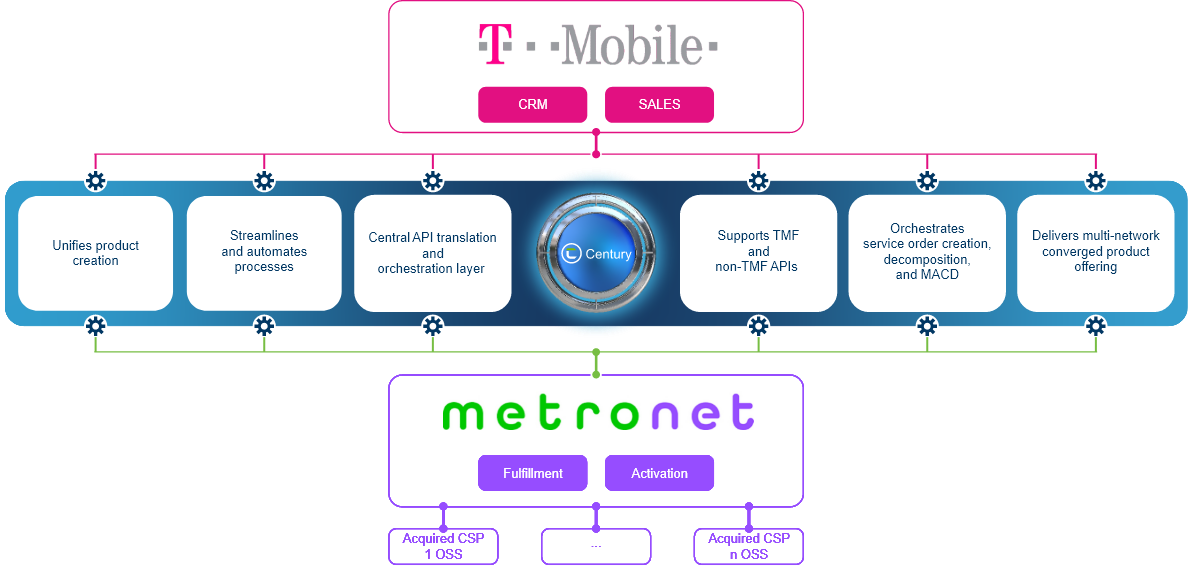
Century Connect was deployed for a Tier 1 mobile operator to support the acquisition of multiple broadband providers without requiring upfront system migration. The solution established a structured path for future system consolidation, creating a reusable framework that enables faster integration of subsequent acquisitions.
Read the full case study here: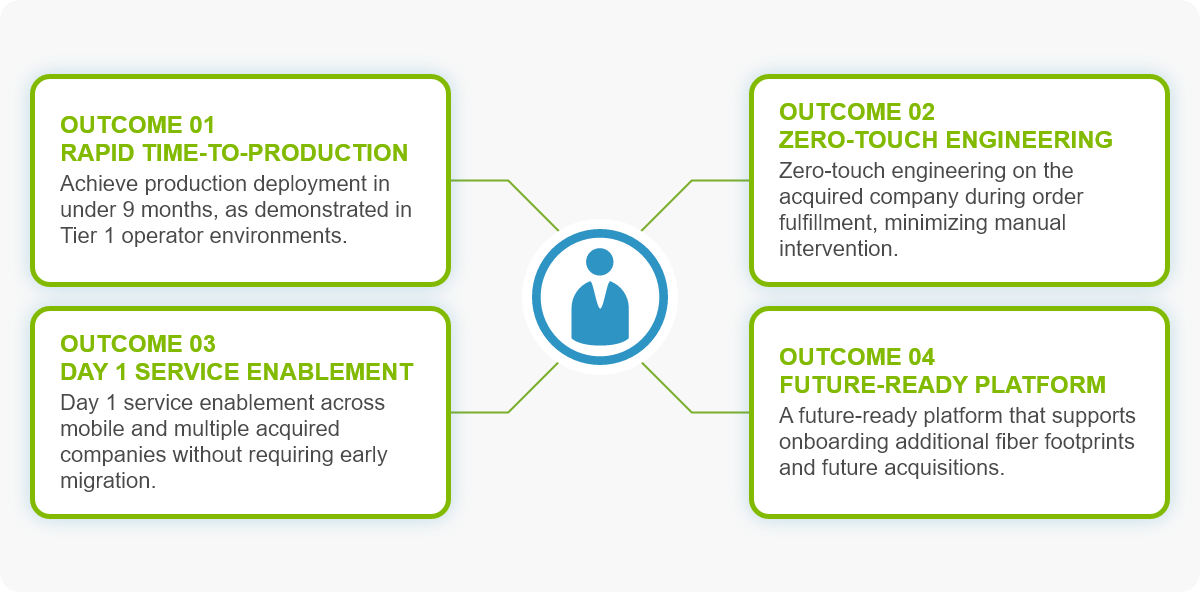
Century Connect differs from the typical telecom M&A tool by allowing companies to generate from Day 1, without requiring any migrations. Our platform avoids the traditional OSS/BSS transformations by building an orchestration layer above the companies’ existing systems.
If you’d like to learn more about Century Connect, click the button below to connect with our team. Whether you want to speak with an expert, request a demo, or discuss your M&A integration strategy, we’d be happy to help.
 GET IN TOUCH Schedule Demos and
Consultations
GET IN TOUCH Schedule Demos and
Consultations